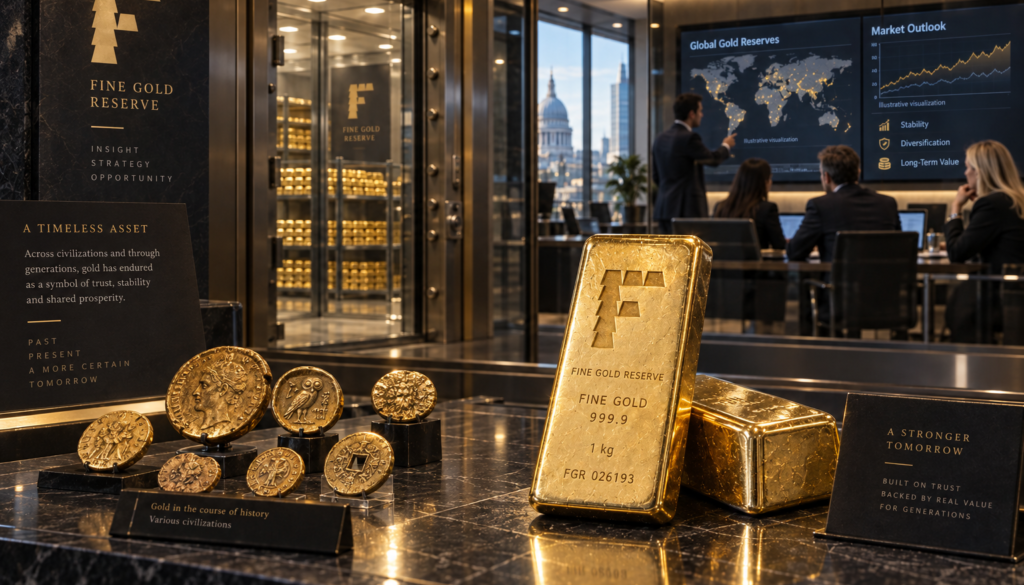
Why Gold Remains the World’s Oldest Money
Introduction
Long before modern banking systems, digital payments, and paper currencies existed, gold served as a trusted medium of exchange, store of value, and symbol of wealth. For thousands of years, civilizations across the globe have recognized gold as money because of its rarity, durability, and universal acceptance.
Today, despite the rise of cryptocurrencies, electronic banking, and fiat currencies, gold continues to hold a unique place within the global financial system. Central banks hold it, investors buy it, and nations accumulate it as part of their strategic reserves.
At Fine Gold Reserve, we believe understanding gold’s monetary history helps investors appreciate why this precious metal continues to play a vital role in preserving wealth.
What Makes Something “Money”?
Throughout history, successful forms of money have shared several key characteristics:
- Durability
- Scarcity
- Portability
- Divisibility
- Uniformity
- Store of value
- Widespread acceptance
Gold possesses all of these qualities, which is why it became one of the most successful forms of money ever used.
Unlike many other commodities, gold does not corrode, decay, or lose its essential properties over time.
Gold’s History as Money
Ancient Civilizations
Gold has been valued for over 5,000 years.
Ancient civilizations in Egypt, Mesopotamia, Greece, China, and Rome used gold as:
- Currency
- Wealth storage
- Trade settlement
- Symbol of economic power
Its rarity and beauty made it highly desirable, while its durability made it practical for long-term use.
The Rise of Gold Coins
As trade expanded, governments began minting gold coins with standardized weights and purity levels.
Gold coins simplified commerce by providing a universally trusted form of payment.
For centuries, gold coins facilitated international trade and economic growth across continents.
The Gold Standard Era
One of the most important chapters in monetary history was the Gold Standard.
Under the Gold Standard:
- National currencies were linked to gold.
- Governments held gold reserves to support their currencies.
- Citizens could often exchange paper money for gold.
This system helped create confidence in currencies because money was backed by a tangible asset with intrinsic value.
Although most countries eventually moved away from the Gold Standard, gold’s influence on global finance remains significant.
Why Gold Outlasted Empires and Currencies
Throughout history, countless currencies have disappeared.
Empires have risen and fallen.
Governments have changed.
Financial systems have evolved.
Yet gold has remained valuable.
This longevity is one of the strongest reasons investors continue trusting gold today.
Gold’s value does not depend on:
- Political promises
- Government policies
- Corporate performance
- Banking systems
Instead, its value is rooted in scarcity, demand, and global trust.
Gold vs Fiat Currency
Modern currencies are known as fiat currencies.
Their value is derived primarily from government authority and public confidence.
Examples include:
- U.S. Dollar
- Euro
- British Pound
- Japanese Yen
- Ghanaian Cedi
Unlike gold, fiat currencies can be created through monetary policy and central bank actions.
Gold differs because:
Limited Supply
Gold cannot be printed.
Its supply grows slowly through mining and recycling.
Intrinsic Value
Gold possesses value independent of government backing.
Global Recognition
Gold is accepted and recognized worldwide.
These characteristics help explain why investors often turn to gold during periods of economic uncertainty.
Why Central Banks Still Hold Gold
If gold is no longer official currency, why do central banks continue holding it?
The answer is simple: trust.
Central banks maintain gold reserves because gold helps:
- Diversify reserve assets
- Preserve long-term value
- Strengthen financial stability
- Reduce currency-related risks
- Enhance confidence in national reserves
Today, thousands of tonnes of gold remain stored in central bank vaults worldwide.
This continued demand reinforces gold’s monetary relevance.
Gold in the Modern Financial System
While people no longer buy groceries with gold coins, gold still performs many monetary functions.
Investors use gold to:
- Preserve wealth
- Hedge against inflation
- Diversify portfolios
- Manage financial risk
- Protect purchasing power
In many ways, gold continues serving as a form of financial insurance within modern portfolios.
Gold and Inflation
One reason gold remains attractive is its historical ability to retain purchasing power over long periods.
When inflation reduces the value of paper currency, investors often seek assets that may better preserve wealth.
Gold’s scarcity and global demand contribute to its reputation as a hedge against long-term currency depreciation.
The Digital Age and Gold
Some observers believed digital currencies would replace gold’s role as a store of value.
Instead, gold has continued attracting investors despite technological change.
Why?
Because gold offers qualities that remain difficult to replicate:
- Physical ownership
- Tangible value
- Global acceptance
- Thousands of years of trust
Technology may change how wealth is transferred, but gold continues to represent enduring financial security.
What This Means for Investors
Gold’s long monetary history provides valuable lessons.
For modern investors, gold can serve as:
Wealth Preservation Tool
Gold has maintained value through centuries of economic change.
Portfolio Diversifier
Gold often behaves differently from stocks and bonds.
Risk Management Asset
Gold may help provide stability during periods of uncertainty.
Long-Term Store of Value
Gold’s scarcity supports its role as a strategic asset.
The Fine Gold Reserve Perspective
At Fine Gold Reserve, we view gold not simply as a commodity but as one of humanity’s most enduring forms of money.
Its ability to preserve wealth across centuries, economic systems, and political environments makes it uniquely valuable in today’s rapidly changing world.
While financial markets continue evolving, the fundamental qualities that made gold valuable thousands of years ago remain just as relevant today.
Conclusion
Gold remains the world’s oldest money because it possesses the qualities that define sound money: scarcity, durability, portability, divisibility, and universal trust.
Although modern economies rely on fiat currencies for everyday transactions, gold continues to serve as a store of value, reserve asset, and symbol of financial security.
From ancient civilizations to modern central banks, gold has maintained its position as one of the most trusted assets in history.
For investors seeking long-term wealth preservation and financial resilience, gold’s remarkable monetary legacy continues to offer valuable lessons and opportunities.
With Fine Gold Reserve, you can own an asset that has stood the test of time and remains trusted by investors, institutions, and governments around the world.