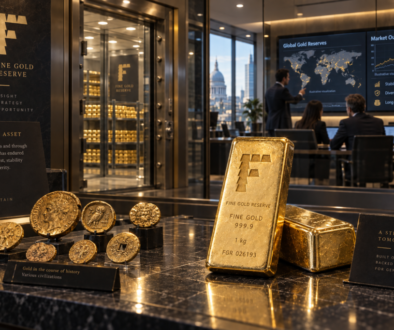
The Role of Gold in Modern Monetary Systems
Introduction
In today’s world of digital banking, electronic payments, and fiat currencies, some investors assume gold no longer plays an important role in the global financial system. However, despite no longer serving as everyday currency, gold remains one of the most strategically important assets held by governments, central banks, financial institutions, and investors.
From supporting national reserves to enhancing financial stability, gold continues to influence modern monetary systems in ways many people overlook.
At Fine Gold Reserve, we believe understanding gold’s role in today’s financial architecture can help investors appreciate why this precious metal remains relevant in an increasingly complex economic environment.
What Is a Modern Monetary System?
A monetary system is the framework through which a country manages money, credit, banking, and financial transactions.
Most nations today operate under a fiat currency system, where money is not backed directly by a physical commodity such as gold.
Instead, the value of modern currencies is supported by:
- Government authority
- Central bank policies
- Economic strength
- Public confidence
- Financial institutions
Although the world moved away from the Gold Standard decades ago, gold continues to play a significant supporting role behind the scenes.
The Transition from the Gold Standard
For much of modern history, currencies were tied to gold through various forms of the Gold Standard.
Under this system:
- Governments held gold reserves.
- Paper money could often be exchanged for gold.
- Currency issuance was linked to available gold reserves.
The global financial system gradually transitioned away from this structure during the 20th century.
Today, currencies are no longer directly convertible into gold. However, governments and central banks continue holding substantial gold reserves, highlighting its ongoing importance.
Why Central Banks Still Hold Gold
One of the strongest indicators of gold’s relevance is the fact that central banks remain among the world’s largest gold holders.
Central banks maintain gold reserves for several key reasons.
1. Financial Stability
Gold helps strengthen national balance sheets and provides an asset that retains value across economic cycles.
2. Reserve Diversification
Holding multiple reserve assets reduces dependence on any single currency or financial instrument.
Gold adds diversification because it behaves differently from many traditional reserve assets.
3. Crisis Protection
During periods of financial instability, gold can provide a source of confidence and liquidity.
4. Long-Term Wealth Preservation
Gold’s limited supply and historical resilience make it an attractive asset for preserving national wealth.
Gold as a Reserve Asset
A reserve asset is something held by governments and central banks to support financial stability and international confidence.
Gold remains one of the most widely recognized reserve assets because it:
- Is globally accepted
- Has no counterparty risk
- Cannot be printed
- Maintains intrinsic value
- Provides diversification benefits
These characteristics help explain why central banks continue accumulating gold despite the existence of modern financial instruments.
Gold and Confidence in Financial Systems
Confidence is one of the foundations of any monetary system.
Investors, businesses, and governments must trust that currencies will maintain value and financial institutions will remain stable.
Gold contributes to this confidence by serving as an independent asset that exists outside traditional banking systems.
Its presence in national reserves can reinforce perceptions of financial strength and preparedness.
Gold’s Role During Economic Uncertainty
Economic uncertainty often highlights gold’s importance.
Periods of:
- Inflation
- Recessions
- Banking stress
- Market volatility
- Currency instability
- Geopolitical conflict
frequently increase demand for gold.
Because gold is viewed as a safe-haven asset, it can help support financial confidence when uncertainty rises.
Gold and Inflation Protection
One reason gold remains relevant is its historical reputation as a store of value.
When inflation reduces purchasing power, investors and institutions often seek assets that may help preserve wealth.
Gold’s scarcity and global demand contribute to its appeal as a long-term hedge against currency depreciation.
Gold in International Finance
Gold continues to influence global finance in several ways.
Central Bank Reserves
Governments use gold to diversify reserve portfolios.
International Confidence
Gold holdings can strengthen perceptions of economic stability.
Strategic Asset Management
Countries use gold as part of broader reserve and risk-management strategies.
Global Liquidity
Gold remains highly liquid and widely traded across international markets.
Why Gold Matters in a Digital Economy
The rise of digital payments, fintech, and cryptocurrencies has transformed how money moves around the world.
However, these innovations have not eliminated the need for trusted stores of value.
Gold remains attractive because it offers:
- Tangible ownership
- Limited supply
- Global recognition
- Historical credibility
- Independence from technology systems
In a world increasingly dependent on digital infrastructure, many investors continue valuing physical assets that exist outside electronic networks.
Gold’s Strategic Importance for Investors
The same reasons central banks hold gold often apply to individual investors.
Potential benefits include:
Portfolio Diversification
Gold may help reduce concentration risk.
Wealth Preservation
Gold has historically maintained value across economic cycles.
Risk Management
Gold can provide stability during periods of uncertainty.
Financial Security
Many investors view gold as a long-term strategic asset.
Future Trends Supporting Gold’s Role
Several developments may reinforce gold’s importance within modern monetary systems over the coming years:
- Continued central bank accumulation
- Rising global debt levels
- Inflation concerns
- Geopolitical uncertainty
- Reserve diversification strategies
- Growing demand from emerging markets
These trends suggest that gold is likely to remain a significant component of global finance for decades to come.
The Fine Gold Reserve Perspective
At Fine Gold Reserve, we view gold as more than a precious metal. It is a strategic monetary asset that continues to play an important role in supporting financial stability, preserving wealth, and strengthening confidence in uncertain times.
Although modern currencies are no longer backed directly by gold, the continued demand from governments, institutions, and investors demonstrates that gold remains deeply embedded in the foundations of the global financial system.
Conclusion
Gold may no longer circulate as everyday money, but its role in modern monetary systems remains remarkably significant.
Central banks continue holding and accumulating gold reserves, investors use gold to preserve wealth, and governments rely on gold as a trusted reserve asset.
Its scarcity, global acceptance, independence, and long history of value preservation ensure that gold remains relevant in a rapidly changing financial world.
For investors seeking stability, diversification, and long-term financial resilience, gold continues to be one of the most important assets available.
With Fine Gold Reserve, you can invest in an asset that has supported monetary systems for centuries and continues to play a vital role in global finance today.